Page 1 of 1
What's in a name?
Posted: Fri Apr 28, 2017 5:32 pm
by Gerard Killoran
An advertisement for the Westminster Chess Club in the John Bull "FOR GOD, THE KING, AND THE PEOPLE!" Sunday newspaper looks very inviting - but check out the name of the billiard table.
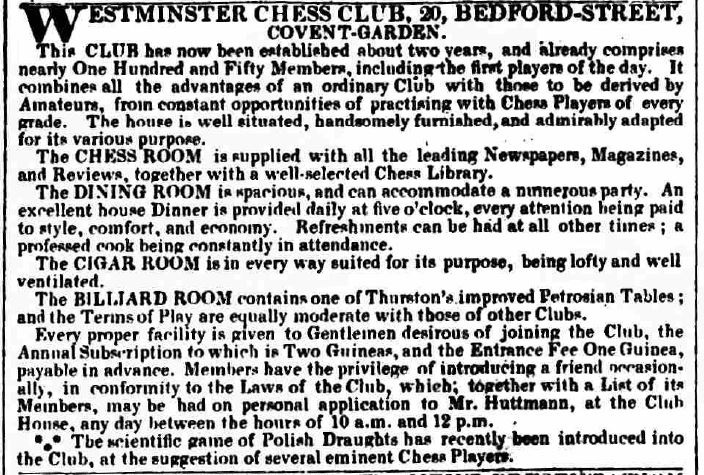
- John Bull Sunday, October 5, 1834.jpg (212.44 KiB) Viewed 1699 times
Re: What's in a name?
Posted: Fri Apr 28, 2017 7:47 pm
by John Townsend
I envy the members of Huttmann's club - but perhaps not their tobacco smoke.
It is interesting to see that a house dinner was provided every day at 5 p.m., with refreshments at other times; and a cook was on hand. I have sometimes wondered what eating/drinking facilities were provided when Staunton was Secretary of the club bearing the same name at 26 Charles Street in 1839. I haven't read of any, and it is unlikely that Huttmann could be matched in that department, though members may have had certain minimum expectations. Huttmann was declared bankrupt in 1838.
Re: What's in a name?
Posted: Sat Apr 29, 2017 8:09 pm
by David Robertson
Membership fee and colossal game fee! At least RdC would get dinner thrown in.
Re: What's in a name?
Posted: Sat Apr 29, 2017 9:53 pm
by Kevin Thurlow
Is perhaps the one guinea a joining fee, rather than a "game fee"? The report is a bit ambiguous. I joined a (non-chess) club today which had an annual sub, but also an application fee...
What is "Polish draughts"? The 10 x 10 version?
Re: What's in a name?
Posted: Sat Apr 29, 2017 10:36 pm
by Tim Harding
Kevin Thurlow wrote:Is perhaps the one guinea a joining fee, rather than a "game fee"? The report is a bit ambiguous. I joined a (non-chess) club today which had an annual sub, but also an application fee...
What is "Polish draughts"? The 10 x 10 version?
1. The text would not have been ambiguous for a Victorian. It was quote normal in those days to pay an admission fee on first joining a club plus the annual subscription.
2. Yes Polish draughts is the version on a 10x10 board with ordinary pieces able to capture backwards and huge swoops along diagonals for the queens/kings. For example if I have a queen on a1 or b2, you have ordinary men on d4 and f6, my queen can take them both and finish on g7 or h8.
Re: What's in a name?
Posted: Sun Apr 30, 2017 10:00 am
by John Townsend
Of course, dinner was a chargeable extra. The sub was less than it could have been. By comparison, in 1839 it was three guineas per annum at the Westminster Chess Club at 26 Charles Street. At the London Chess Club it was for a long time three guineas (four guineas for the first year including the entrance fee).
Play was available for a big part of the day and went on until about midnight, so you could spend a lot of time there if you chose. There was no "game fee", though it was usual to agree a small stake for each game, perhaps a shilling.
Re: What's in a name?
Posted: Sun Apr 30, 2017 8:27 pm
by Kevin Thurlow
Thanks to Tim for clarification.